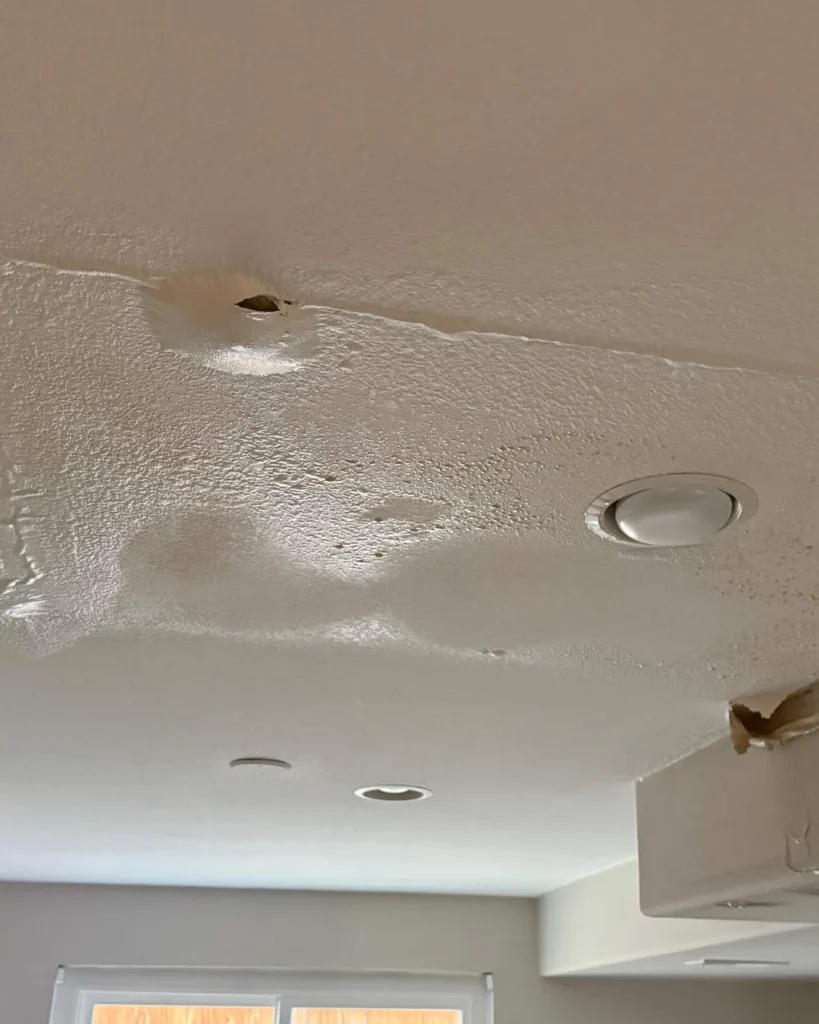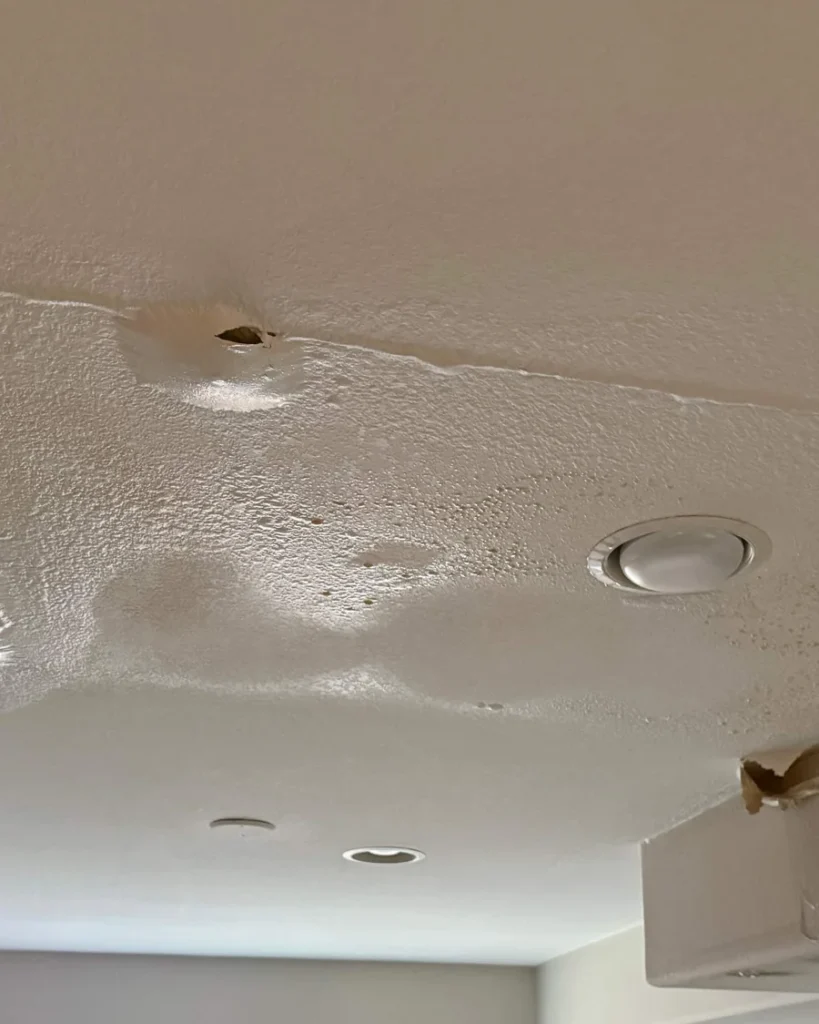
It’s a horrible feeling. You come home from a day at work or a long weekend to find water all over the place. It’s all over the floors or dripping from the ceiling. There’s a moment of panic. What’s happening? How bad is this? How much is this going to cost?
Usually, this points to a water line break: either a supply line to an appliance or fixture failing, or a pressurized pipe in your wall splitting.
The questions pile up quickly along with the anxiety. Obviously, the first thing to do is shut the water off. From there, we can start to help put things in order.
Pipe Burst? What to Do in the First Hour
There are two priorities that rise to the top simultaneously when a pipe bursts in your home: getting the source fixed, and containing the damage. In the restoration industry, these are two distinct, separate actions that can happen at the same time. Restoration companies typically do not repair broken pipes, and plumbers typically aren’t equipped to handle mitigation projects.
However, plumbers and restoration companies can and should work well together. We have a number of plumbers we’ve worked with for years that we’re happy to recommend or even coordinate. Additionally, in situations where a pipe is broken behind the wall, we can often help plumbers narrow down the spot to make the repair.
If you’re not sure where to start, get us on the phone at (303) 660-6216 and we can help put a game plan together. It doesn’t matter what time, day or night. Water lines can burst at any hour, so we’re available around the clock as well.
Pipe Burst Water Damage: What You Can Do In The Meantime
It’s natural to want to take action to get things under control. If that sounds like you, here are some things you can do while waiting for crews to arrive.
What’s useful in the next hour:
- Take pictures and video before anything moves. If you need to file a claim, having documentation is essential. Wide shots of the entire room capture many details, while close-up photos of damage to your belongings and furniture are also useful.
- Get your contents up off the floor. We’re happy to move furniture and belongings; if you have any items you’re concerned about, feel free to protect them while you wait.
- Figure out your deductible. Not every water loss justifies a claim, and you shouldn’t file one before you have all the details. Filing a claim doesn’t affect whether the damage must be addressed, but knowing your deductible helps you make smart decisions going forward.
Pipe Burst Water Damage: What Does This Mean for My House?
Some wet materials can be dried in place. Some can’t. Drywall that’s wet but not damaged and doesn’t have insulation behind it, for example, can often be saved. A saturated wood subfloor below tile, however, often doesn’t dry well. It may require the tile to be removed. We do our best to determine what can be saved or dried in place and what might actually be cheaper to just replace.
Beyond considering what can be dried and what should be removed, determining how far the water actually traveled through the structure is important. Water is absorbed quickly by drywall, moves through grout lines, and gets under wood floor and cabinetry. It’s absorbed by the padding under the carpet. In these situations, the surface often looks and even feels dry. When a significant amount of water is involved, professional moisture metering is important to determine the extent of the damage.
A few things we look at after a pipe breaks inside a wall:
- Drywall with insulation behind it. Fiberglass batt doesn’t necessarily absorb water like a sponge does, but it still traps moisture between its fibers, and inside a closed wall it has no way to dry on its own.
- The carpet and the pad. Pad saturates fast and moves water beyond what can be seen on the surface of the carpet. Pet-barrier pad, in particular, has a protective barrier that holds water against the subfloor, effectively doing its job in reverse during a pipe burst.
- Water that may have gotten behind or under cabinets. When a water line breaks and water moves down levels, it can seep behind or under cabinets, or become water damage in the basement. Trapped moisture like this can foster mold growth within 24 to 48 hours, and Colorado is not too dry for mold.
What to Do Right Now
Give us a call. Tell us what you’re seeing, and we’ll help you determine the next best steps. We’re happy to do a free damage assessment in person to help sort things out.
It’s common to be unsure whether a claim should be filed first before involving a company like ours. We’ve worked with all insurance carriers and hundreds of local agents for years. Insurance agents usually recommend that a company like ours be on site first to provide an estimate and assess the likelihood of coverage.
Call (303) 660-6216 in the Denver metro or (719) 922-6448 in Colorado Springs, any time. Or read more about our water damage restoration process.
Key Takeaways
- Getting the pipe fixed and containing the water are two separate jobs, and they can happen at the same time. You don’t have to pick an order.
- We don’t repair pipes, but we’ll recommend a plumber we trust or coordinate one for you, and we can often help them find the break.
- Photograph the room before anything moves, then get your contents up off the floor.
- Some of what’s wet can be dried in place, and some of it can’t. What the water touched, and how far it traveled, is what decides.
- Knowing your deductible helps you decide about a claim. It doesn’t change whether the damage needs to be dealt with.
Frequently Asked Questions
Either one, and you don’t have to choose. The repair and the water are separate jobs that run at the same time. Call us first and we’ll help with the plumbing side, including recommending or coordinating a plumber we’ve worked with. Called a plumber first? That’s fine too. Just don’t let the repair hold up dealing with the water.
That’s the one where guessing costs you. The insulation and framing get wet before anything shows on the surface, and a closed cavity has no way to dry on its own. Breaks behind a wall are also hard to locate, which is where our metering helps the plumber as much as it helps us. Same story when a hose bibb breaks inside a wall.
Not necessarily. With clean water from a broken supply or water line, the pad often doesn’t have to come out. It saturates fast and moves water past what you can see, so it needs looking at, but a soaked carpet is not automatically a lost carpet. Pet-barrier pad is the exception. Its backing holds water against the subfloor instead of letting it dry.
It’s worth a phone call at least. Sometimes the cleanup you did is the whole story. Sometimes there’s more behind the baseboard. It doesn’t cost anything to find out, and we can often do it from a few photos.
Forefront Building + Restoration has been restoring Colorado homes for over 20 years, with IICRC-certified technicians across the Denver Front Range.